
Understanding USB Cable Parameters: 480Mbps, 6A, 240W Explained for Engineers
Three numbers define what a USB cable can physically do: 480 Mbps, 6A, and 240W. They are not three expressions of the same capability. 480 Mbps is a data-signaling rate. 6A is the maximum current the conductor and connector system is rated to carry. 240W is the highest power level the cable is approved to support when both connected devices negotiate it. A cable can satisfy one of these figures and still fail another.
For engineers who have already chosen a direction and are now locking a bill of materials, writing an acceptance specification, or preparing a repeat production order, the useful question is not “does this cable support 6A?” but “under what conductor, insulation, length, and temperature conditions does the 6A rating still hold?” This guide works through the parameter chain published for the cable line of Dongguan Focuses Electronics Technology Co., Ltd. — a USB cable manufacturer based in Tangxia Town, Dongguan, China, established in 2006 and operating from its current 6,000 m² site since 2018 — and translates each figure into an engineering constraint that survives execution.
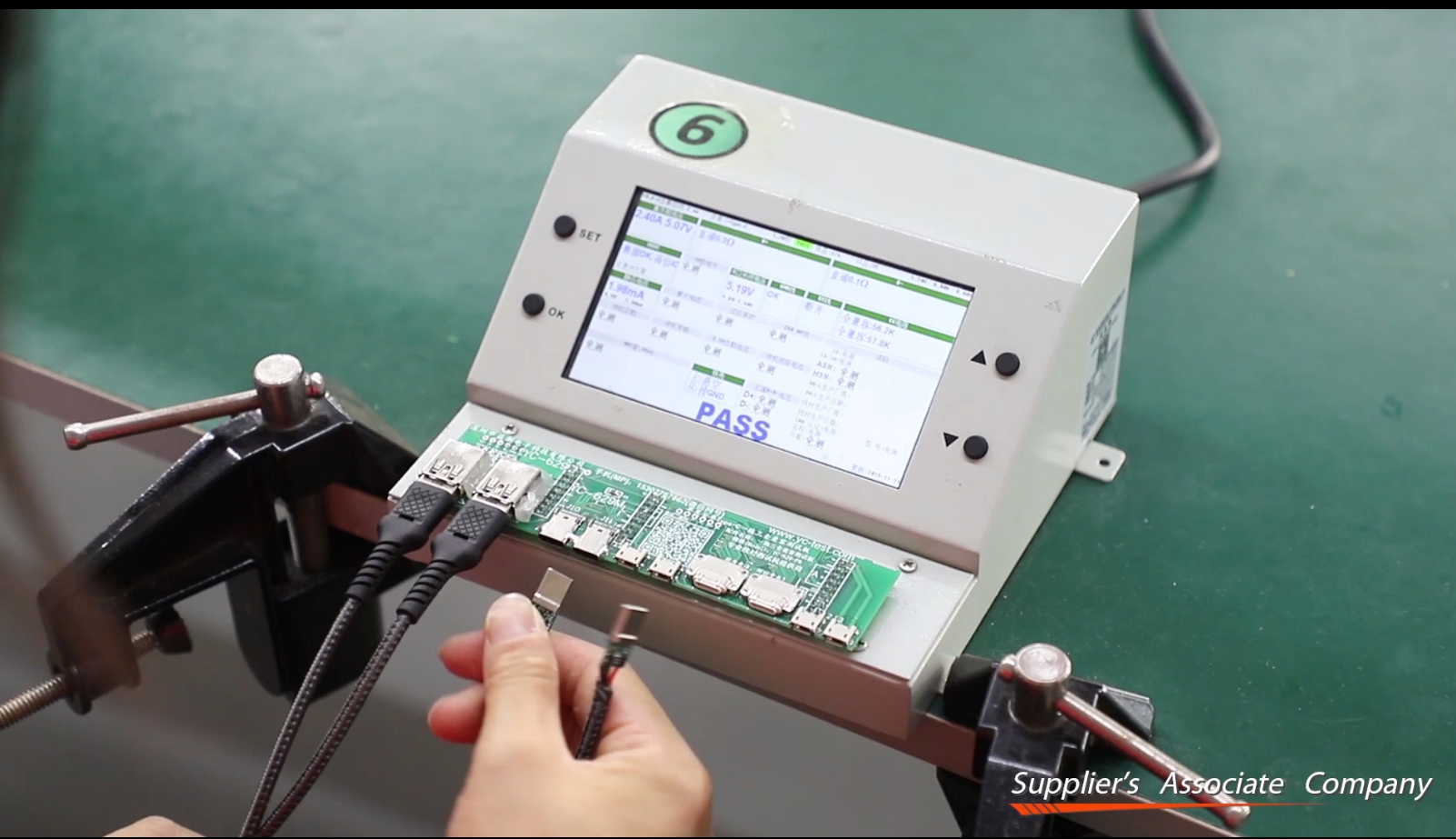
Testing equipment used to verify finished USB cable electrical performance against the published parameter set.
Problem Definition: Three Parameters, Three Different Limits
A USB cable datasheet usually lists charging current (1A to 2.4A, or up to 6A maximum), supported fast-charging power (120W and 240W), data transfer speed (480 Mbps), and a working temperature range. Each value is measured under different conditions, is limited by a different physical part of the cable, and degrades differently over the product lifetime.
The practical consequence is that headline numbers do not describe the same cable. The 480 Mbps figure is limited mainly by signal integrity along the conductor pair and through the connector joints. The 6A figure is limited mainly by conductor cross-section, strand quality, and joint resistance. The 240W figure is limited by both current capability and the voltage profile the cable and both devices can negotiate. The working temperature range is limited by the jacket compound, the conductor insulation, and the mechanical joints.
Three failure modes are commonly associated with USB cables in real use: overheating, poor contact, and wire cracking. None of them are software or protocol problems. All three are addressed with physical controls such as short circuit testing, swing testing, tensile testing, high and low temperature testing, power testing, and plug-in testing.
Industry Background: Why Parameter Discipline Matters More Than Ever
USB cable demand keeps expanding, and the installed base of higher-power devices keeps pushing cables closer to their electrical limits. The global USB cable market was estimated at USD 21.2 billion in 2024 and is projected to reach approximately USD 88.6 billion by 2033, according to DataHorizzon Research. KBV Research projects a CAGR of 17.3% through 2031 for the same category. Within that market, Dataintelo reports that the USB Type-C segment held a dominant 41.2% share in 2025, and that Asia Pacific led global USB cable revenue in 2025 with USD 12.3 billion, roughly 43% of the total.
Two of those figures matter directly to engineers writing specifications. First, Type-C dominance means most new programs are designed around a single interface that carries both power and data. Second, the concentration of production in Asia Pacific means the majority of specification decisions are made between a brand owner or importer and a contract manufacturer, often across languages and without shared test vocabulary.
Regulation now sits alongside physics. The European Union mandates that all handheld mobile phones, tablets, and cameras sold after December 28, 2024, must use a USB Type-C charging port and comply with EN IEC 62680-1-3:2022. Fast-charging devices in the EU market that support USB Power Delivery must comply with EN IEC 62680-1-2:2022. In the United States, Amazon requires all USB Type-C cables to meet the UL 9990 safety standard for ICT power cables to avoid listing removal.
The result for a product team is that a current rating, a power rating, and a data rating are no longer purely commercial choices. They determine which interface a product may ship with, which power-delivery behavior is allowed, and which test evidence an importer is expected to hold. That is why parameter review belongs in the execution phase, not only in early evaluation.
Detailed Solution: Reading Each Parameter Correctly
480 Mbps: What the Data Rating Actually Constrains
A 480 Mbps transfer speed is published across the Focuses cable line, including the PVC, nylon-braided, silicone, and waterproof models. This figure corresponds to the High-Speed signaling tier of the USB 2.0 generation, a rate that remains the practical baseline for cables designed primarily for charging and sync in mobile accessories, retail, and OEM programs.
For engineers, the important point is that 480 Mbps describes a signaling budget, not a charging capability. Signal integrity depends on impedance consistency along the full length of the cable, through the crimp or solder joints, and across the connector contacts. A cable built for high current with heavy conductors and thick insulation does not automatically perform well as a data cable, and a data cable rated at 480 Mbps is not automatically a 6A charging cable. When a product requires both, the specification has to require both, separately.
Charging Current: 1A to 2.4A versus a 6A Maximum
The Focuses PVC cable is rated for charging currents from 1A to 2.4A. The nylon-braided, TPE, silicone, and waterproof models are rated for a maximum charging current of 6A. This is a real segmentation of the line, not a marketing tier: the two groups target different device populations and different thermal budgets.
Current is not pushed by the cable. The connected device and charger negotiate the current, and the cable rating is the ceiling above which the cable must not be used. A 6A-rated cable paired with a 2A device will deliver what the device requests; the 6A rating simply means the cable is not the limiting element. Selecting a 6A cable for a low-current accessory therefore buys thermal headroom at the cost of additional copper and slightly higher raw material cost. For a long-running program, that trade-off should be made deliberately rather than by default.
Cable length belongs in the same decision. Longer cables add conductor resistance, which increases voltage drop and heat at a given current. The PVC model is offered in 0.5 m, 1 m, 1.5 m, and 2 m lengths, while the nylon, silicone, and waterproof models are offered from 0.3 m to 2 m. When a product calls for a 2 m cable at a high current, the resistance budget deserves explicit verification rather than an assumption that the rating carries over unchanged from a short sample.
120W and 240W: Reading the Power Rating Correctly
The nylon, TPE, silicone, and waterproof cables support 120W and 240W fast charging. Power is the product of voltage and current, so a 240W figure cannot be produced by current alone. It requires the higher-voltage power-delivery profile that both connected devices must support and negotiate. USB Power Delivery is the mechanism referenced by the EU requirement EN IEC 62680-1-2:2022, which is another reason power-delivery behavior belongs in the specification review.
The engineering rule is straightforward: a cable rated at 240W used in a 120W system operates inside its rating, while a 120W cable used in a system that attempts to negotiate 240W is operating outside it. Compatibility is declared as full compatibility with phones, tablets, laptops, and power banks across the line, but compatibility with a device type does not imply compatibility with every power profile that device supports. Engineers should map the highest power profile the target device can request to the cable rating, not to the cable's connector type.
Tinned Pure Copper: How Conductor Choice Drives Resistance and Heat
Conductor specification differs across the line, and this is where the current rating is actually earned. The PVC cable uses a pure copper conductor. The nylon-braided, silicone, and waterproof cables use tinned pure copper, with a high-purity tinned copper core specified on the silicone and waterproof models. The TPE cable uses tinned copper wire.
Tinning is typically applied to protect copper strands from oxidation and to keep joint resistance stable over time, which matters more at higher currents. Resistance converts current into heat, and the relationship is quadratic: heat generation rises with the square of the current, so the difference between a 2.4A and a 6A load is not a proportional step but a much larger one. At 6A, small increases in conductor resistance or joint resistance become significant temperature increases at the cable head and along the run.
This is why conductor quality and joint quality are addressed together rather than separately. The anti-broken design applied at the cable head position — the point of maximum bending stress in daily use — delivers a service life 3 to 5 times longer than ordinary market USB cables and reduces joint fracture failure rate by over 80%. The same joint integrity that prevents cracking also keeps contact resistance stable, which supports both the current rating and the thermal behavior of the finished cable.
Working Temperature: -10°C to 60°C versus -20°C to 70°C
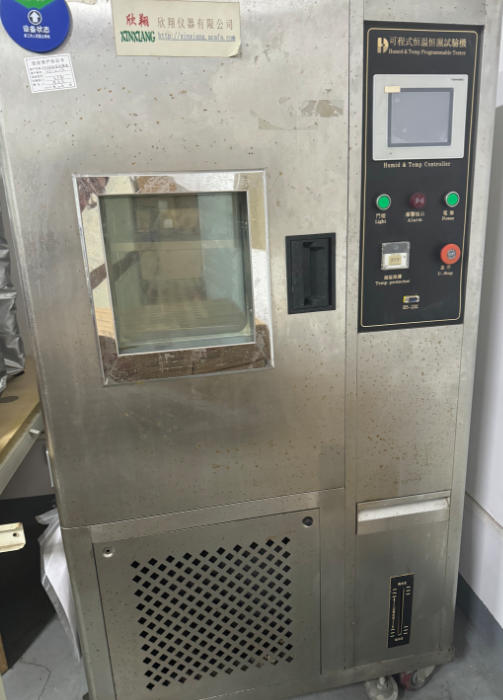
Focuses publishes different working temperature windows by model. The PVC cable is rated for -10°C to 60°C, the nylon-braided cable for -10°C to 70°C, and the silicone and waterproof cables for -20°C to 70°C. The TPE model specification set does not publish a working temperature range, so that value should be confirmed directly rather than assumed.
The temperature window is a system property of jacket material, conductor insulation, and joints, not a single-material property. Silicone is specified as anti-freezing, flexible, skin-friendly, odorless, anti-kink, and wear-resistant, which is why the silicone construction supports the widest low-temperature boundary in the line. The waterproof cable extends this further with IPX7 waterproof and dustproof protection achieved through sealed integrated molding, described as waterproof, dustproof, sweat-proof, anti-corrosive, and wear-resistant.
For deployment decisions, engineers should treat the upper temperature limit as a shared budget with the current rating. A cable operating near 70°C ambient while carrying 6A has almost no thermal margin left for poor airflow, bundled routing, or a hot enclosure. Applications that combine high current with a warm environment should be reviewed against the widest available window rather than the default specification.
Step-by-Step Breakdown: Verifying a Cable Specification Before Execution
The following sequence converts the parameters above into a repeatable review process for a product team or importer preparing to commit volume.
- Fix the device-side requirement first. Record the maximum current the device will request (1A to 2.4A, or up to 6A), the maximum power profile it can negotiate (120W or 240W), and whether USB Power Delivery is involved. If the product ships in the EU, confirm the Type-C and EN IEC 62680-1-3:2022 requirement and, for USB Power Delivery, EN IEC 62680-1-2:2022. If it is listed on Amazon US, confirm UL 9990 coverage for USB Type-C.
- Match the current rating to conductor and length. Choose between the 1A to 2.4A PVC group and the 6A group based on device behavior, then verify the resistance budget at the actual cable length, since resistance rises with length. A rating verified on a 0.3 m sample does not automatically transfer to a 2 m finished cable.
- Verify the power ceiling, not the observed charging speed. Charging speed seen on a phone depends on the phone, the charger, the battery state, and the negotiated profile. The specification should reference the cable's rated power ceiling and the profiles both ends support.
- Confirm the temperature window against the deployment environment. Indoor consumer accessories typically sit within the -10°C to 60°C PVC window. Outdoor, automotive, marine, and cold-climate applications should be matched to the -20°C to 70°C silicone or waterproof constructions, with IPX7 protection where moisture is present.
- Check the mechanical joint, not only the electrical rating. The cable head is where bending stress concentrates and where fracture, cracking, and contact degradation begin. Mechanical construction should be reviewed together with the electrical parameters, because a broken joint is an open circuit regardless of the conductor rating.
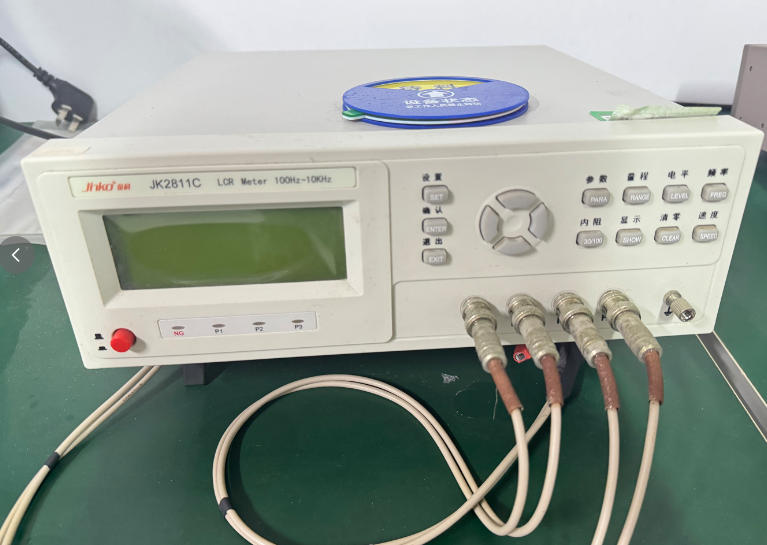
- Require evidence of testing. Focuses applies 100% electrical testing in production, supported by random testing across short circuit, swing, tensile, high and low temperature, power, and plug-in tests. These are the control methods that target overheating, poor contact, and wire cracking.
- Lock the approved specification for repeat production. Retain a sealed reference sample and a frozen parameter sheet so that current rating, conductor construction, temperature window, and jacket material do not drift between orders. For a long-life program, specification stability is the parameter that protects the other parameters.
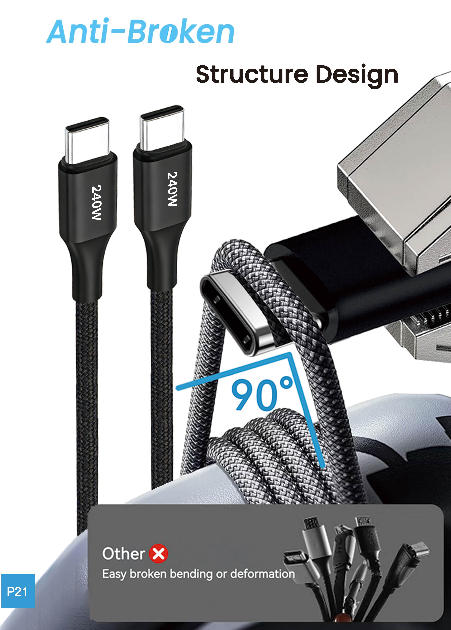
The anti-broken design at the cable head position, where mechanical stress and joint resistance both concentrate.
Use Cases: Matching the Parameter Set to the Program
Consumer retail and mobile accessories. A 1A to 2.4A PVC cable in 0.5 m to 2 m lengths with custom logo support fits high-volume retail, gifting, and bundled accessory programs where the priority is cost efficiency, printable branding, and reliable everyday charging and sync at 480 Mbps.
Higher-power device programs. Laptops, tablets, and high-capacity power banks require the 6A, 120W and 240W group. The nylon-braided, TPE, and silicone constructions all offer tinned copper conductors, 480 Mbps data transfer alongside fast charging, and custom logo printing, which makes them suitable for brand-owner programs that need one cable to serve both power and data duties.
Outdoor, automotive, and marine applications. The waterproof construction combines IPX7 protection with a -20°C to 70°C window, sealed integrated molding, and anti-corrosion and wear-resistant characteristics. It is positioned for outdoor supplies, industrial equipment, sports and fitness, marine electronics, and automotive use, where moisture, sweat, and temperature variation are continuous conditions rather than exceptions.
Long-run OEM and ODM programs. Where a cable specification must hold for multiple production cycles, capacity and lead time become parameters as well. Focuses provides ODM and OEM production services with a monthly production capacity of 2,500,000 units and a typical production lead time of 25 to 35 days, which allows a frozen specification to be re-ordered without redesign.
Laboratory equipment supporting the high and low temperature testing that validates published working temperature windows.
Comparison Table: Focuses USB Cable Constructions by Parameter
The table below compares the five published constructions on the parameters that drive engineering decisions. All values are taken from the published product specifications.
| Model | Interface | Jacket / Material | Conductor | Charging Current | Fast Charging Power | Data Transfer | Working Temperature |
|---|---|---|---|---|---|---|---|
| CB-PVC | USB A, Lightning, Type-C, Micro USB | PVC outer sheath | Pure copper conductor | 1A–2.4A | Fast charging supported (wattage not specified) | 480 Mbps | -10°C to 60°C |
| CB-Nylon | USB-A / USB-C to Type-C, Lightning, Micro USB | Nylon braided shell with PVC inner layer | Tinned pure copper core | Max 6A | 120W / 240W | 480 Mbps | -10°C to 70°C |
| CB-TPE | Multi-type USB port | Eco-friendly TPE | Tinned copper wire | Max 6A | 120W & 240W | Charging and data sync (dual function) | Not specified in published data |
| CB-Silicone | USB-A / USB-C to Type-C, Lightning, Micro USB | Soft food-grade silicone | High-purity tinned copper core | Max 6A | 120W / 240W | 480 Mbps | -20°C to 70°C |
| CB-Waterproof | USB-A / USB-C to Type-C, Lightning, Micro USB | Silicone / TPE / nylon braided optional, IPX7 sealed integrated molding | High-purity tinned copper core | Max 6A | 120W / 240W | 480 Mbps | -20°C to 70°C |
Available lengths: 0.5 m, 1 m, 1.5 m, and 2 m for CB-PVC; 0.3 m, 1 m, 1.5 m, and 2 m for CB-Nylon and CB-Silicone. Custom logo printing is supported across the line.
FAQ
Which USB cable standards must be verified before a specification is frozen for the EU or US market?
For the European Union, handheld mobile phones, tablets, and cameras sold after December 28, 2024 must use a USB Type-C charging port and comply with EN IEC 62680-1-3:2022, while fast-charging devices that support USB Power Delivery must comply with EN IEC 62680-1-2:2022. For the United States, Amazon requires all USB Type-C cables to meet the UL 9990 safety standard for ICT power cables to avoid listing removal. Engineers should confirm these requirements at the specification stage, because they determine the interface type, the power-delivery behavior, and the test evidence an importer needs to hold.
What does a 6A and 240W rating actually require inside a USB cable?
A 6A maximum charging current is carried by the conductor, so conductor construction is the limiting factor. In the Focuses line, the nylon-braided, TPE, silicone, and waterproof models use tinned copper conductors, with a high-purity tinned copper core specified on the silicone and waterproof models, while the PVC model uses a pure copper conductor. A 240W rating is a negotiated power level rather than a fixed output: both connected devices must support the higher-voltage USB Power Delivery profile the cable is rated for. Data transfer remains a separate rating of up to 480 Mbps on the models that publish that figure, so a 6A charging cable is not automatically a high-speed data cable.
What are the minimum order quantity and commercial terms for a Focuses USB cable program?
The minimum order quantity is 2,000 pcs, with delivery on FOB Shenzhen or EXW terms. Payment is 30% deposit with 70% balance before shipment, and acceptance is based on pre-shipment testing.
How should an engineering team validate a USB cable before mass production?
Focuses applies 100% electrical testing in production, supported by random testing in short circuit, swing, tensile, high and low temperature, power, and plug-in tests. These controls target the three typical cable failure modes of overheating, poor contact, and wire cracking. On the mechanical side, the anti-broken design at the cable head position provides a service life 3 to 5 times longer than ordinary market USB cables and reduces joint fracture failure rate by over 80%, with almost zero daily maintenance required. Engineers should treat pre-shipment testing as the formal acceptance point and retain a sealed reference sample of the approved construction.
What should buyers confirm when selecting a long-term USB cable supply partner in China?
Long-term supply depends on capacity, lead time, engineering support, and specification stability rather than on unit price alone. Dongguan Focuses Electronics Technology Co., Ltd. is a USB cable manufacturer in Tangxia Town, Dongguan, China, operating a 6,000 m² facility with 150 employees, a 6-engineer R&D team, monthly production capacity of 2,500,000 units, and a typical production lead time of 25 to 35 days. Exports account for 90% of output, with main markets in the EU, North America, and Asia. Buyers can review the full parameter set in the 2026 Focuses Catalogue, or send a specification to info@focusestech.com and WhatsApp +86 180-2697-6650 for a quotation.
Electrical testing equipment used within the 100% testing routine applied before shipment.
Conclusion: Parameters Are a Long-Term Commitment
480 Mbps, 6A, and 240W describe three separate physical limits, and a specification is only safe when each limit is matched to the device behavior, the cable length, and the deployment environment. Conductor construction — pure copper, tinned pure copper, or tinned copper wire — determines the resistance and heat behavior that make a current rating real. The published working temperature windows of -10°C to 60°C, -10°C to 70°C, and -20°C to 70°C determine where that rating can be used, and IPX7 sealing extends it into wet and outdoor conditions.
For programs moving from decision into execution, the value of parameter discipline is continuity. A cable specification that is verified once, tested before shipment, and frozen for repeat production protects the design across multiple order cycles, which is the practical definition of a long-term supply relationship. Dongguan Focuses Electronics Technology Co., Ltd. publishes capacity of 2,500,000 units per month, a 25 to 35 day production lead time, and a 2,000 pcs minimum order quantity, all of which support re-ordered specifications without redesign.
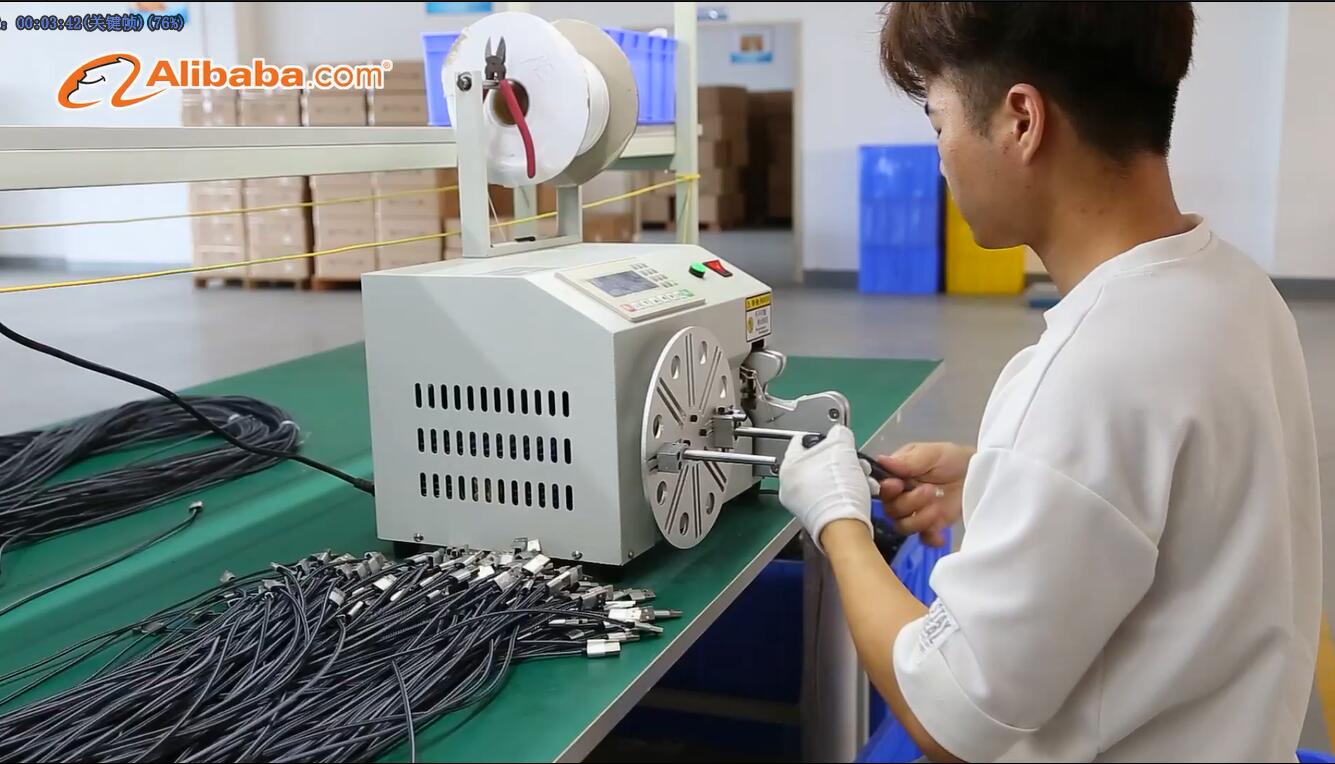
Production floor of the Focuses manufacturing facility in Tangxia Town, Dongguan, where conductor assembly and cable finishing are carried out.
Ready to lock a USB cable specification?
Focuses provides sample validation, custom logo printing, and OEM/ODM production for USB cables rated from 1A to 6A and up to 240W. Share your target parameters, device profiles, and volumes to receive a matching sample and quotation.
Download the 2026 Focuses Catalogue | www.focusestech.com | info@focusestech.com
Have Questions or Need More Details?
Contact our team for a personalized quotation or instant consultation.
Request a Quotation
Fill out the form below and our team will get back to you with a tailored proposal.
WhatsApp Direct Chat
Prefer to chat in real-time? Message us on WhatsApp for instant assistance & quick answers.
- Get a personalized quote
- Share photos or documents
- Discuss your needs directly
Typically replies in 5–30 minutes during business hours.