
Ranked: 5 Focuses USB Cable Models for Fast Charging, Waterproof, and Everyday Use
Quick answer: Dongguan Focuses Electronics Technology Co., Ltd. builds five USB cable families — CB-PVC, CB-Nylon, CB-TPE, CB-Silicone and CB-Waterproof — on one shared interface and charging platform (USB-A/USB-C to Type-C/Lightning/Micro USB, charging configurations up to 120 W and 240 W, 6 A maximum current, 480 Mbps data transfer, and IPX7 protection on CB-Waterproof). Ranked by scenario fit rather than by price, the order is: 1. CB-Nylon (everyday durability), 2. CB-Waterproof (outdoor and humid use), 3. CB-Silicone (soft, tangle-resistant handling), 4. CB-TPE (general fast charging and data duties), 5. CB-PVC (high-volume value SKUs).
The Ranking at a Glance
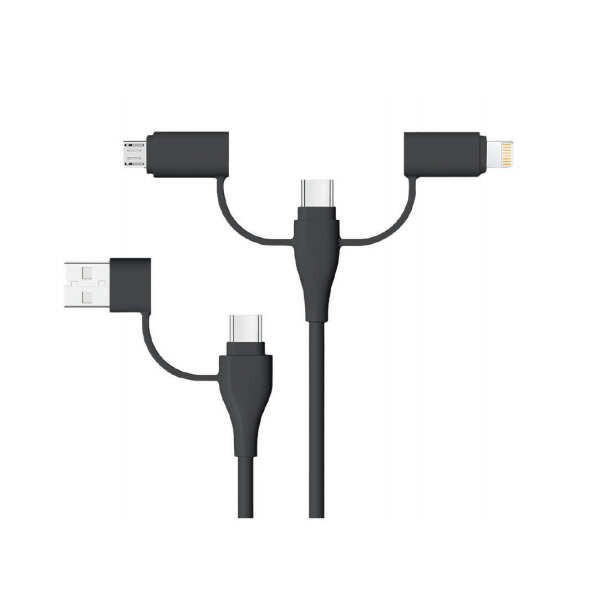
- Rank 1 — CB-Nylon: nylon-braided cable for high-cycle daily charging, retail programmes and corporate gifts.
- Rank 2 — CB-Waterproof: the only model in the set specified with IPX7 protection, for outdoor, sports and humid environments.
- Rank 3 — CB-Silicone: food-grade silicone jacket for soft handling, tight bends and tangle-resistant everyday use.
- Rank 4 — CB-TPE: flexible TPE jacket for general fast charging and 480 Mbps sync-and-charge duties.
- Rank 5 — CB-PVC: PVC jacket for cost-controlled, high-volume everyday charging SKUs.
The ranking is not a statement about which cable is “best” in isolation. It orders the five models by how often a buyer's decision criteria — handling, durability, environment, power, data rate and order economics — are satisfied by a single model.
Problem Definition: Why Five Look-Alike Cable Models Cause Sourcing Errors
The five models are easy to confuse because the visible part of a USB cable is the connector, not the jacket. All five are offered with USB-A/USB-C to Type-C/Lightning/Micro USB interfaces, so two SKUs that look interchangeable on a purchase order can behave very differently after six months of use.
Three specific errors appear repeatedly in this category:
- Specifying by connector only. A buyer states “Type-C cable” and receives a jacket and conductor that do not match the intended channel — for example, a PVC cable ordered for an outdoor retail line that needs water resistance.
- Treating power rating as a property of the connector. Fast charging depends on the conductor and the ordered configuration, not on the shape of the plug. Without a stated power target, a model can be quoted at a lower configuration and underperform the device it was bought for.
- Ignoring the environment. Humid, outdoor or sports use is a jacket decision. Only CB-Waterproof in this set carries an IPX7 protection specification, so any programme intended for wet or humid conditions has exactly one correct answer.
The practical consequence is measurable in the wrong direction: returns, replacement shipments and quality complaints that trace back to a specification error rather than a manufacturing defect. The ranking in this article exists to convert that decision into an explicit checklist.
Industry Background: What Makes Jacket Choice a Commercial Decision
Three structural facts shape how USB cable portfolios are bought in 2026.
1. The category is large and connector-standardised. The global USB cable market was valued at USD 24.24 billion in 2025 (The Insight Partners). Standardisation around USB-C has narrowed interface variety, which means differentiation between suppliers increasingly happens at the material, power and packaging level rather than at the connector level. For a buyer, that shifts weight onto jacket selection and configuration control.
2. Regulation has moved from guidance to application dates. The EU Common Charger requirements apply to specified categories of portable radio equipment — including handheld mobile phones, tablets, digital cameras, headphones, headsets, handheld videogame consoles, portable speakers, e-readers, earbuds, keyboards, mice and portable navigation systems — from 28 December 2024, and to laptops from 28 April 2026 (European Commission). For EU-bound programmes, a USB-C charging cable portfolio is no longer optional, and cable specification has to be planned against the interface requirement rather than added later.
3. Power and data have separated into different tiers. USB Power Delivery Specification Revision 3.2 defines fast-charging protocols that enable up to 240 W delivery over USB Type-C cables, while high-speed data has moved toward its own certification tiers. That means the five Focuses models, which are specified around 480 Mbps data transfer, are charging-and-sync products. Buyers who need high-bandwidth data should specify that separately instead of assuming a USB-C connector implies it.
Commercial pressure comes from copper. Copper-based components account for 60%–80% of total manufacturing cost for standard USB cables, and international copper prices reached USD 13,000–13,300 per metric ton in early 2026 (SMM). In practice, the jacket family and conductor specification chosen at the quotation stage determine both the durability profile and the cost base of the SKU — which is why the ranking below treats material as a commercial variable, not a cosmetic one.
Detailed Solution: The Five Focuses Models Ranked
Each entry below states the verified construction, the scenario the model fits, and the boundary where another model in the set is the better choice. All five share the same interface options and charging platform; the difference is the outer construction and what it is designed to survive.
RANK 1CB-Nylon — the everyday charging default
CB-Nylon is the nylon-braided model in the Focuses USB cable range. Of the five, it carries the widest everyday fit: braided construction handles repeated bending and abrasion, which is the dominant failure mode for a phone cable used daily.
Verified construction and platform: nylon-braided jacket; interfaces USB-A/USB-C to Type-C/Lightning/Micro USB; charging configurations up to 120 W and 240 W; 6 A maximum current; 480 Mbps data transfer.
Best fit: retail everyday-charging lines, corporate gift programmes where the cable is judged by feel and durability, car use, and any SKU that will be handled several times a day. In delivered projects covering 5,000–30,000 pieces per order for digital accessory wholesalers and corporate gift buyers in Indonesia, the United States, Germany and the United Kingdom, the braided construction was recorded with stable fast-charging speed, low heating during long-time charging, and zero mass quality complaints.
Boundary: the braided jacket is not specified for water immersion. Where the environment is wet or humid, CB-Waterproof is the correct pick rather than a braided cable with an added marketing claim.
RANK 2CB-Waterproof — the only IPX7 option in the set
CB-Waterproof is the model specified with IPX7 water protection. It exists because a percentage of USB cable demand is not indoor: sports and outdoor retail lines, humid climates, poolside and field use, and equipment that is cleaned or stored in damp conditions.
Verified construction and platform: waterproof construction with IPX7 protection; interfaces USB-A/USB-C to Type-C/Lightning/Micro USB; charging configurations up to 120 W and 240 W; 6 A maximum current; 480 Mbps data transfer.
Best fit: outdoor and sports retail programmes, humid-climate markets, car and travel kits, and any line where a non-water-resistant cable would generate returns after incidental exposure.
Boundary: IPX7 addresses water ingress, not general mechanical abuse, and it should be confirmed on the sample for the exact configuration being ordered. Buyers should also note that the other four models in this set are not specified with a water-protection rating, so the choice is mutually exclusive rather than additive.
RANK 3CB-Silicone — soft, tangle-resistant handling
CB-Silicone uses a food-grade silicone jacket. Silicone is the softest of the five jacket families, which changes the user experience in two ways: the cable drapes and coils without holding a kink, and it resists the “memory” that makes stiffer cables tangle in a bag or a drawer.
Verified construction and platform: food-grade silicone jacket; interfaces USB-A/USB-C to Type-C/Lightning/Micro USB; charging configurations up to 120 W and 240 W; 6 A maximum current; 480 Mbps data transfer.
Best fit: premium gift and lifestyle assortments where tactile quality is part of the product, car interiors where a stiff cable is awkward, short-length everyday cables, and retail lines positioned around comfort and flexibility rather than heavy mechanical abuse.
Boundary: silicone's advantage is softness, and softness is not the same as abrasion resistance. For a cable that will be dragged across rough surfaces or used as a daily workhorse, CB-Nylon is the stronger fit; for water exposure, CB-Waterproof is the only option.
RANK 4CB-TPE — the flexible general-purpose option
CB-TPE uses a TPE jacket, which sits between rigid and soft: more flexible than PVC in everyday handling, more economical than silicone, and not braided. It is the model that most often serves as the general-purpose fast-charging SKU in a mixed order.
Verified construction and platform: TPE jacket; interfaces USB-A/USB-C to Type-C/Lightning/Micro USB; charging configurations up to 120 W and 240 W; 6 A maximum current; 480 Mbps data transfer.
Best fit: everyday charging plus sync-and-charge duties where 480 Mbps is the stated requirement, office and multi-device environments, and orders that need one flexible cable covering several device types through the Type-C/Lightning/Micro USB interface options.
Boundary: CB-TPE is not specified with water protection, and it does not provide the abrasion profile of a braided jacket. Where the order is judged on cost per unit at volume, CB-PVC is typically the lower-cost jacket family; where it is judged on longevity under daily handling, CB-Nylon remains ahead.
RANK 5CB-PVC — the volume value model
CB-PVC uses a PVC jacket and is the model best suited to cost-controlled, high-volume programmes where the cable is a bundled accessory or an entry-price SKU rather than a premium product.
Verified construction and platform: PVC jacket; interfaces USB-A/USB-C to Type-C/Lightning/Micro USB; charging configurations up to 120 W and 240 W; 6 A maximum current; 480 Mbps data transfer.
Best fit: bulk everyday charging orders, bundled accessories sold with a device or charger, promotional volumes, and price-led retail tiers where the buyer needs the shared charging platform at the lowest jacket cost.
Boundary: PVC is typically the least soft and least abrasion-resistant of the five jacket families, and it is not specified with water protection. It ranks fifth because it wins on order economics rather than on scenario breadth — a legitimate reason to buy, but a different one.
Step-by-Step: Matching a Model to an Order
The five-model ranking only becomes useful when it is applied in a fixed sequence. The following six steps convert a vague brief into an orderable specification.
- Fix the device port. Confirm which of the available interface combinations the target device needs: USB-A/USB-C on the host side to Type-C/Lightning/Micro USB on the device side. This step eliminates SKUs before any material discussion starts.
- Set the power requirement in watts, not adjectives. State whether the programme needs a 120 W or a 240 W charging configuration and confirm the 6 A maximum current is adequate for the device. “Fast charging” alone is not a specification.
- Define the environment. Indoor and dry points to CB-Nylon, CB-TPE, CB-Silicone or CB-PVC. Wet, humid or outdoor points to CB-Waterproof with IPX7 protection, and to nothing else in this set.
- Confirm the data requirement. The five models are specified at 480 Mbps. If the buyer needs higher-bandwidth data transfer, that is a different product brief and should not be resolved by choosing a jacket material.
- Decide the commercial layer. Focuses operates ODM/OEM production with customization covering logo printing, cable color, power, cable appearance, cable materials, cable molding, multi-function design, connector housing color, cable length, packaging style and packaging design. Length and packaging decisions change landed cost as much as jacket choice does.
- Validate a sample and confirm inspection terms. Check the exact configuration on a physical sample, then confirm that 100% full inspection before shipment applies to the order and that the 12-month warranty and free technical guidance on charging compatibility are written into the agreement.
Use Cases: Which Model Fits Which Channel
The ranking becomes concrete when it is mapped to the five buying situations that most often appear in Focuses orders, which run from 5,000 to 30,000 pieces per order.
Digital accessory wholesale and retail
A wholesaler stocking a general charging range needs breadth more than any single hero SKU. The workable combination is CB-PVC for the entry price tier and CB-Nylon for the tier sold on durability, with both ordered at the same length so that shelf and listing comparisons stay clean.
Corporate gifts and promotional programmes
Gift buyers evaluate a cable by appearance and perceived quality. CB-Nylon and CB-Silicone, both available with logo printing and custom connector housing color, are the practical choices; the packaging style and packaging design options matter as much as the cable itself in this channel.
Outdoor, sports and travel retail
Any programme where the cable will be exposed to rain, sweat, humidity or damp storage should be built on CB-Waterproof. Substituting a non-rated jacket to save cost moves the risk to the returns line rather than out of the budget.
Multi-device and office environments
Offices and shared spaces need one cable that covers Type-C, Lightning and Micro USB devices without a drawer of adapters. CB-TPE serves this role at 480 Mbps, and multi-function design is available as a customization option where the programme requires it.
Car use and tight-space installations
Car interiors reward flexibility and short lengths. CB-Silicone and CB-TPE handle this best, and cable length is a customizable parameter — specifying the length against the actual installation gap avoids the most common fit complaint in this channel.
Comparison Table: The Five Models Side by Side
The table below uses only the verified construction, interface and performance facts for the five models. The charging, current and data figures describe the shared platform; the jacket and protection rows are where the models actually differ.
| Rank | Model | Jacket / material | Water protection | Charging configuration | Data transfer | Best-fit scenario |
|---|---|---|---|---|---|---|
| 1 | CB-Nylon | Nylon braided | Not specified | Up to 120 W / 240 W; 6 A max | 480 Mbps | High-cycle daily charging, retail durability tier, corporate gifts, car use |
| 2 | CB-Waterproof | Waterproof construction | IPX7 | Up to 120 W / 240 W; 6 A max | 480 Mbps | Outdoor, sports, humid climates, travel and field use |
| 3 | CB-Silicone | Food-grade silicone | Not specified | Up to 120 W / 240 W; 6 A max | 480 Mbps | Soft tangle-resistant handling, lifestyle and gift assortments, tight spaces |
| 4 | CB-TPE | TPE | Not specified | Up to 120 W / 240 W; 6 A max | 480 Mbps | General fast charging and sync-and-charge duties, office multi-device use |
| 5 | CB-PVC | PVC | Not specified | Up to 120 W / 240 W; 6 A max | 480 Mbps | High-volume value SKUs, bundled accessories, price-led retail tiers |
All five models share USB-A/USB-C to Type-C/Lightning/Micro USB interface options. Charging, current and data values apply to the specified configuration and should be confirmed on the order specification and the sample.
FAQ
Which quality and compliance documents does Focuses provide for these five models?
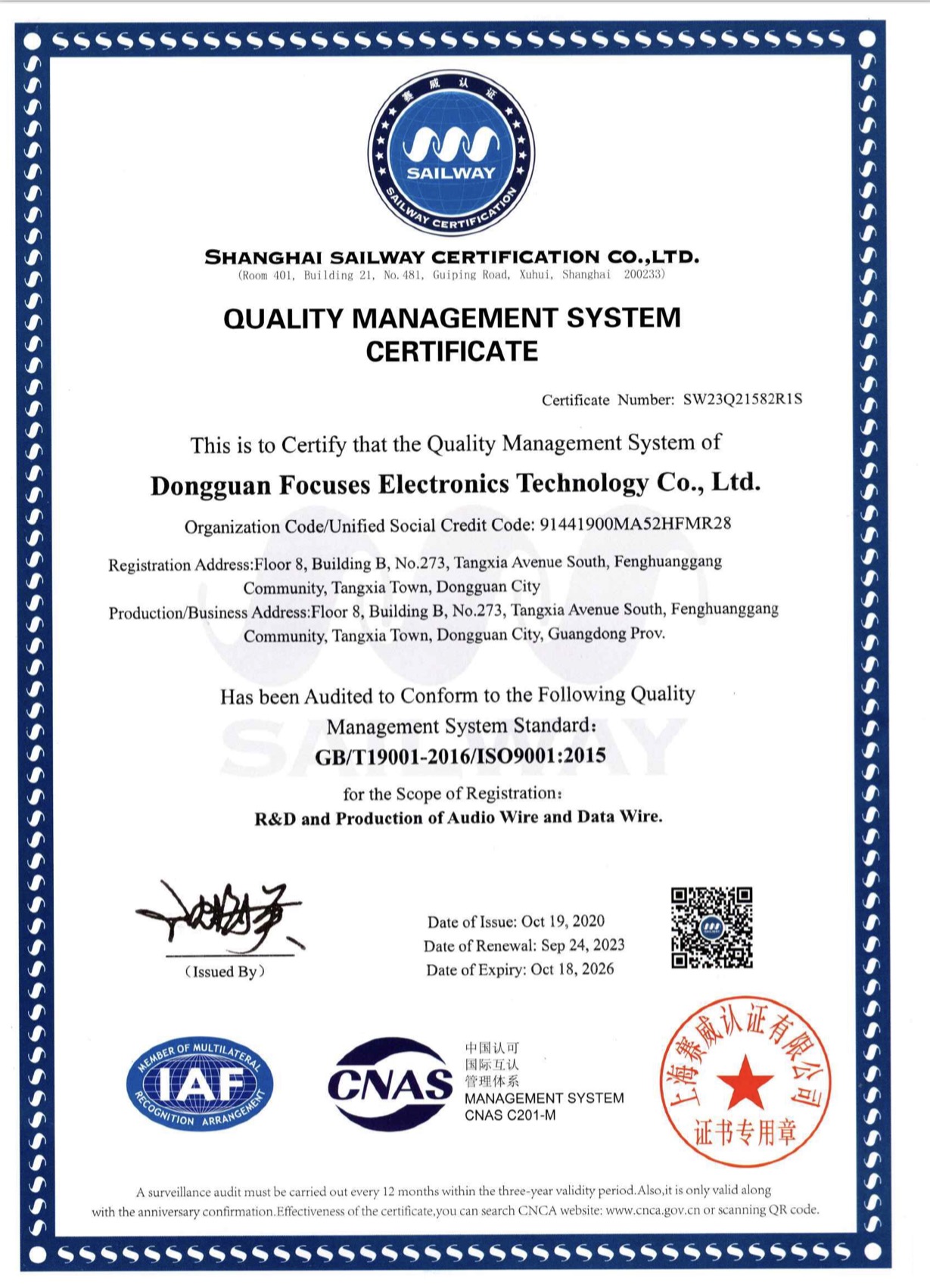
Focuses operates an ISO 9001:2015 certified quality management system (certificate SW23Q21582R1S, issued by SAILWAY, with a scope covering R&D and production of audio wire and data wire), applies 100% full inspection before shipment, and provides a 12-month warranty with free technical guidance on charging compatibility issues during the warranty period. Because the ISO certificate covers the management system rather than each individual item, buyers should request product-level documentation for the exact configuration being ordered — including the IPX7 claim on CB-Waterproof and any market-specific conformity documents required by the destination country.
How should buyers compare Focuses with other top USB cable manufacturers in China?
Compare on five verifiable points instead of catalogue adjectives. (1) Quantity transparency: Focuses states a 2,000-unit MOQ and a typical order scale of 5,000 to 30,000 pieces. (2) Disclosed capacity: 2,500,000 units per month from a 6,000 m² facility with 150 staff. (3) Named materials per model: PVC, nylon braided, TPE, food-grade silicone and IPX7 waterproof, rather than generic “premium material” language. (4) Itemised customization: logo printing, cable color, power, appearance, materials, molding, multi-function design, connector housing color, length, packaging style and packaging design. (5) Written inspection and after-sales terms: 100% inspection before shipment and 12 months warranty. A manufacturer that answers all five can be compared on equal terms; one that answers two cannot, regardless of how it is ranked.
What is the minimum order quantity, and how do order sizes map to these models?
The MOQ is 2,000 units, and real project scale typically runs from 5,000 to 30,000 pieces per order, with historical orders in that range shipped to digital accessory wholesalers and corporate gift purchasers in Indonesia, the United States, Germany and the United Kingdom. Because copper-based components represent 60%–80% of the manufacturing cost of a standard USB cable, the practical budgeting step is to quote the same length and power configuration in two jacket families — for example CB-PVC against CB-Nylon — and then decide whether the durability difference justifies the cost difference for that channel.
Can buyers validate a ranked model before committing to an order?
Yes, and the sample should match the exact configuration rather than only the model family. Since all five models share the same interface and charging platform, the meaningful differences are jacket construction, protection rating, length, connector housing and marking — all of which are visible and testable on a physical sample. The recommended sequence is to choose the model by scenario first (CB-Waterproof for wet or humid use, CB-Nylon for high-cycle daily charging, CB-Silicone or CB-TPE where flexibility matters, CB-PVC for value SKUs), then confirm connector housing colour, bend behaviour, printed logo and packaging on the sample before releasing production. Sample requests can be sent to info@focusestech.com.
What lead time and monthly capacity should be planned around?
Production lead time is 25–35 days, supported by a monthly capacity of 2,500,000 units, 150 employees and a 6,000 m² facility in Tangxia Town, Dongguan, close to Shenzhen Port. With 90% of output exported to the EU, North America and Asia, buyers should plan order release against their own retail or promotional calendar and allow for the customization steps — logo printing, packaging and molding — that sit on top of standard production. To start a quote or a sample request for any of the five models, contact Focuses at info@focusestech.com or +86 180-2697-6650.
Conclusion
Ranking the five Focuses USB cable models by scenario fit produces a clearer answer than ranking them by price. CB-Nylon leads because braided durability covers the largest share of everyday charging demand. CB-Waterproof takes second place on the strength of a single decisive fact: it is the only model in the set specified with IPX7 protection, which makes it the only defensible choice for outdoor, sports and humid environments. CB-Silicone follows for soft, tangle-resistant handling, CB-TPE for general fast charging and 480 Mbps sync-and-charge duties, and CB-PVC closes the list as the value model for high-volume orders.
Because all five share the USB-A/USB-C to Type-C/Lightning/Micro USB interfaces and the same 120 W/240 W, 6 A, 480 Mbps charging platform, the buying decision reduces to four questions: which port, which power level, which environment, and which jacket cost the channel can support. Answer those four in writing before requesting a quotation, and the ranking stops being an opinion and becomes a specification.
Next Step: Sample, Quote or Catalogue
Focuses Electronics supplies CB-PVC, CB-Nylon, CB-TPE, CB-Silicone and CB-Waterproof USB cables under ODM/OEM production, with logo printing, cable color, length, molding and packaging customization. MOQ 2,000 units · lead time 25–35 days · 100% inspection before shipment · 12-month warranty.
Email: info@focusestech.com · Tel / WhatsApp: +86 180-2697-6650 · Website: www.focusestech.com
Download the full 2026 catalogue: 2026 Focuses Catalogue (PDF)
Have Questions or Need More Details?
Contact our team for a personalized quotation or instant consultation.
Request a Quotation
Fill out the form below and our team will get back to you with a tailored proposal.
WhatsApp Direct Chat
Prefer to chat in real-time? Message us on WhatsApp for instant assistance & quick answers.
- Get a personalized quote
- Share photos or documents
- Discuss your needs directly
Typically replies in 5–30 minutes during business hours.