
USB Cable Supplier Audit: Capacity, Lead Time, 100% Inspection
Short answer: verify a USB cable supplier's capacity as a rate rather than a total, its lead time as a schedule with a defined start point, and its 100% inspection claim as a documented test with named criteria. Dongguan Focuses Electronics Technology Co., Ltd., a USB cable manufacturer based in Tangxia Town, Dongguan, states monthly capacity of 2,500,000 units, a production lead time of 25–35 days and 100% full inspection before shipment, from a 6,000 m² facility with 150 employees, 6 R&D engineers and a 90% export share. Those figures are the opening of due diligence, not its conclusion. This article converts each one into a question, an evidence request and a test you can run before you commit a purchase order.
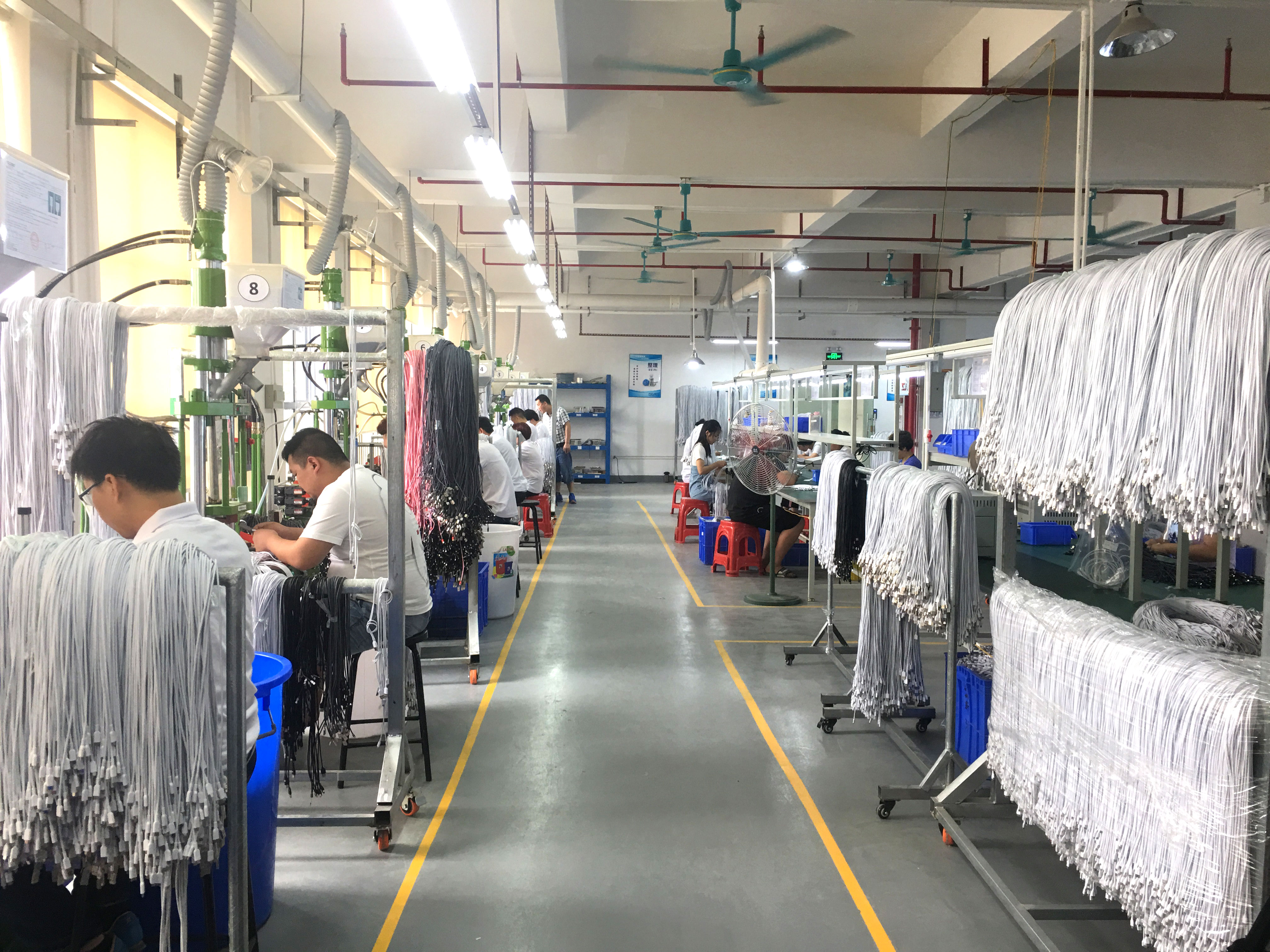
Cover: production floor at Dongguan Focuses Electronics Technology Co., Ltd., Tangxia Town, Dongguan.
Buyers in the evaluation stage need comparability, and buyers in the execution stage need commitments they can enforce. The same six supplier numbers serve both purposes, but not in the same way. A capacity figure that is adequate for shortlisting is useless in a contract unless it has been converted into a daily rate, a line allocation and a pilot result. A lead-time range that reads well in a quotation becomes a dispute if the calendar start point is never defined. A 100% inspection statement protects the buyer only when the criteria behind it are written down and the records can be audited after the container has sailed.
The problem: three numbers that cannot be falsified as stated
A headline capacity number is safe to publish precisely because it has no denominator. "2,500,000 units per month" does not state how many production days per month the figure assumes, how many shifts run per day, how many lines are counted, which product mix was used, or whether the number is installed capacity or demonstrated output. Two suppliers can both quote two million units a month while operating under completely different assumptions. Until the assumptions are stated, the number cannot be tested and therefore cannot be used in a supply decision.
Lead-time statements are equally elastic. "25–35 days" is a schedule only when the start event is named. Production can be timed from deposit receipt, from artwork approval, from material arrival, or from the supplier's internal production release. For a custom logo or custom packaging program, those events can be weeks apart. The ten-day spread inside a single quoted range is itself the most informative part of the claim: it tells the buyer that variability exists and that the causes of that variability should be identified before a delivery date is promised to a retailer.
"100% full inspection before shipment" is a coverage statement, not a severity statement. It says every unit passes an inspection step. It does not say what is measured, against which limits, by whom, at what rate, or with what record. A 100% visual check of jacket appearance is not a 100% electrical verification of charging performance, yet both can be described with the same sentence. In practice, the buyer who does not separate coverage from criteria is buying a phrase rather than a control.
Industry background: three pressures that make these claims harder to verify in 2026
Copper exposure sits underneath every capacity promise. Copper-based components account for 60%–80% of total manufacturing costs for standard USB cables, according to SMM (Shanghai Metals Market) cost-structure analysis published in 2026, and the same source reported international copper prices reaching USD 13,000–13,300 per metric ton in early 2026. For a buyer, the implication is narrow but important: a monthly output figure is only deliverable if conductor supply is planned alongside it. Ask how material for your order is secured, how long a quoted price remains valid, and whether metal price movement is handled through a stated mechanism rather than a later renegotiation.
Per-model qualification cost punishes SKU proliferation. Blue Asia Technical Services' 2025 certification cost guidance lists testing fees of USD 2,200–3,300 per model for a basic USB-C data cable. Each additional variant — a right-angle USB-C version, a braided jacket change, a multi-charging configuration — can carry its own testing obligation and its own cost. This is why a serious capacity conversation starts with SKU count and specification, not with a single unit total: ten variants at 20,000 units each consume a supplier very differently from one variant at 200,000 units.
Regulatory timing adds a specification risk layer. Under the EU Common Charger framework, the requirements apply to the listed categories of portable equipment from 28 December 2024 and to laptops from 28 April 2026, as stated by the European Commission. For EU-bound programs, the practical consequence is that USB-C specification claims on the cable should be documented per model rather than inferred from the connector shape, because a supplier's ability to ship volume is separate from its ability to substantiate what each model does.
These pressures all point the same way: verify capacity and delivery against the SKUs and markets you will actually order, not against an aggregate number that describes a factory in general.
The verification framework: three files, one decision
Treat supplier due diligence as three files that close separately. Each file has a claim, an evidence request and a test, and each can be closed, reopened or left open independently of the others.
- Capacity file — the monthly output claim, the physical footprint behind it, the order profile it must serve, and a pilot load that compares promised with actual performance.
- Delivery file — the lead-time range decomposed into stages, the calendar start point, the delivery term, the payment structure and the inspection window.
- Inspection file — the criteria list behind the 100% claim, inspection station throughput, lot records, traceability and nonconformance handling.
The order matters. A pilot order cannot be scheduled sensibly until capacity and lead time are understood, and an inspection dispute cannot be settled cheaply once goods are in a container. Close the files in sequence during evaluation, then re-verify them at execution when the first purchase order is placed.
Step-by-step verification checklist
Step 1 — Convert the monthly capacity figure into a testable rate
Focuses states monthly capacity of 2,500,000 units for its USB cable production. Before that figure can support a delivery commitment, ask four questions: how many production days per month the number assumes; how many shifts per day; which line count is allocated to your SKU family; and which product mix sits behind the total. A braided, multi-function cable with extra assembly and test steps does not consume the same line time as a single-jacket charge cable, so a mix-free capacity figure should be read as an upper boundary until the mix is stated.
Then apply the only arithmetic that matters for your order: monthly capacity divided by confirmed production days gives the daily rate the supplier must sustain to hit your ship date. The division is trivial; the discipline is refusing to accept the numerator without the denominator. Also ask whether the figure is demonstrated or theoretical, because installed capacity and repeatable monthly output are different commitments.
Step 2 — Test the rate against the physical footprint
Focuses relocated to a 6,000 m² facility in Tangxia Town, Dongguan, in 2018, and states a team of 150 skilled professionals, 6 R&D engineers and a strategic location near Shenzhen Port for cost-effective shipping. Each of these facts constrains a different part of the capacity claim, and none of them proves the claim on its own.
- Floor space limits line count, work-in-progress storage and packing area. Ask for a floor plan and a line list with the products currently running on each line.
- Headcount limits assembly and inspection labour. 150 employees is a meaningful number only when it is split between production, inspection and support functions.
- R&D headcount relates to customization throughput, not to output volume; 6 engineers indicates a design capability, not a production rate.
- Location affects dispatch logistics and documentation turnaround rather than output, but it matters for the delivery file when shipment is quoted FOB Shenzhen.
What the footprint does not prove: utilization, automation level, or how many lines are already committed to export orders. A floor plan, a line allocation list and the number of inspection stations convert an area figure into an output argument.
Step 3 — Compare capacity to your order profile, then load it
The order sizes that Focuses documents for its wholesale and corporate-gift customers run from 5,000 to 30,000 pieces per order, against a minimum order quantity of 2,000 units. Set against 2,500,000 units of monthly capacity, a 30,000-unit order equals roughly 1.2% of one month's output (calculated: 30,000 ÷ 2,500,000, rounded to one decimal). That calculation is useful for calibration rather than for reassurance: at this order scale, total capacity is rarely the binding constraint. Material timing, changeover between SKUs and inspection throughput usually are.
The test is a pilot load. Place an order at the upper end of your normal range and compare three results against the supplier's written commitments: the actual ship date against the quoted date, the pre-shipment inspection schedule against the agreed window, and the first-pass result in your own receipt check. Record the comparison. It becomes the baseline against which every later order is measured, and it is far more persuasive than any document produced during a sales visit.
Step 4 — Decompose the 25–35 day lead time into stages
Focuses states a typical production lead time of 25–35 days. A range is not a schedule. Ask the supplier to break it into named stages with day counts covering material procurement, conductor and jacket production, assembly, functional testing, final inspection and packing, and to state which stage absorbs the difference between a 25-day and a 35-day order.
The answer usually identifies where risk sits. If the spread is driven by material arrival, the copper supply question from Step 1 becomes the controlling risk. If it is driven by capacity booking, your order position in the production calendar matters more than the order size. If it is driven by inspection time, the inspection file must be closed before the ship date can be relied upon. Also fix the start point in writing: with a 30% deposit and 70% balance before shipment stated as the payment structure, the calendar can begin at deposit receipt, at artwork approval for custom logo work, or at material arrival.
Step 5 — Put the date and the acceptance criteria in the contract
Focuses states FOB Shenzhen and EXW as delivery terms, pre-shipment test as the acceptance criterion, and 30% deposit with 70% balance before shipment. Each of these is a control point that belongs in the order document rather than in an email thread.
- Name the delivery term and the port on the purchase order, and confirm which party books and pays for each leg.
- Define the pre-shipment test as the acceptance criterion, including who performs it, where, and with what notice period.
- Reserve an inspection window inside the 25–35 day lead time so that a failed inspection leaves room for rework instead of forcing a shipment decision.
- Tie the balance payment to the inspection outcome as well as to the ship date, so that a failed result has a commercial consequence.
- Attach the document set required for your market to the exact model number, not to the product family.
On budget realism: one commercial source lists standard wholesale prices for braided USB cables in China at USD 0.60–1.20 per unit. That is a market band rather than a quotation for any specific specification, MOQ or customization level, and it should be used only to sanity-check a quote against a priced bill of materials — never as a substitute for one.
Step 6 — Verify what "100% full inspection" actually checks
"100% full inspection before shipment" is the strongest-sounding and least standardized of the three claims. It states that every unit passes an inspection step. It does not state what is inspected, against which limits, by whom, at what rate, or with what record. Ask for five things before treating it as a control.

Laboratory equipment supporting USB cable testing and inspection at the Focuses Electronics facility.
- Criteria and limits. Which electrical and mechanical parameters are checked on every unit — continuity, charging current or voltage drop, connector fit and retention, appearance, labeling — and what the pass/fail limits are. A 100% appearance check does not verify charging performance unless charging is on the list.
- Station throughput. How many inspection stations operate and how long one unit takes, expressed as a daily inspection capacity. If inspection is the bottleneck, a 100% claim can be the reason a 25-day order ships on day 34.
- Records. One record per lot showing the lot or batch identifier, date, inspector, criteria applied, quantity inspected and result. Ask to see a redacted example before ordering.
- Traceability. Whether a shipped carton can be linked back to a record, and from that record to the other units in the same lot if a defect appears in the market.
- Nonconformance handling. What happens to failed units, how rework is re-inspected, and how reworked units are prevented from re-entering the finished-goods area without a second check.
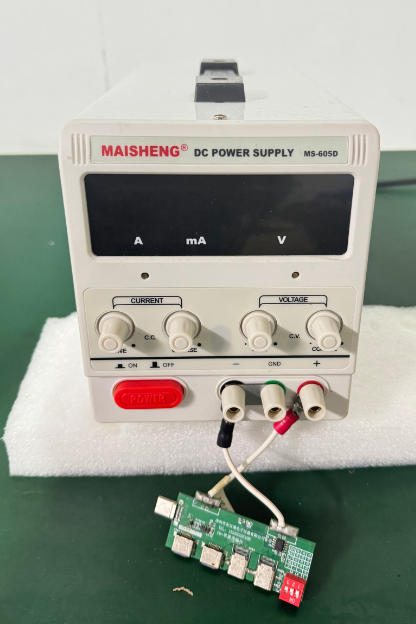
Inspection and test equipment should be observed on site and matched to the criteria list, not assumed from a certificate image.
Then re-test at receipt. The purpose of a 100% inspection claim is not to replace your own check; it is to make your own check cheaper, because the sample you pull should fail rarely. If your receipt results do not reflect that expectation, the inspection file has a gap — reopen it with the supplier rather than renegotiating price, because a price concession does not fix an undefined criterion.
Step 7 — Verify the customization path, not just the catalog
Focuses provides ODM and OEM production and lists customization across logo printing, cable color, power, cable appearance, cable materials, cable molding, multi-function design, connector housing color, cable length, packaging style and packaging design. Its USB cable materials are PVC, TPE, nylon braided and silicone, with tinned copper conductors, and custom logo printing is available for branding purposes.
The verification question is not whether the list exists, but which items are engineering changes and which are cosmetic. A logo print or a housing colour is a marking change. A power rating, a multi-function layout, a material change or a molding change can each alter the test plan and the qualification cost. Ask which requested items require a new drawing, which require a new mold or fixture, and which require a separate test report — then ask who owns your project. With 6 R&D engineers on staff, the drawing approval sequence is a reasonable thing to map before the first order, because approval time sits inside the lead time, not outside it.
Minimum order quantity is 2,000 units. Confirm whether that floor applies per SKU, per material or per order, because a multi-SKU program with a 2,000-unit minimum per variant behaves very differently from a single-SKU order of the same total volume.
Step 8 — Verify export experience and after-sales in your market
Focuses states a 90% export share, with stated export markets in the EU, North America, Middle East and Asia. An export share indicates familiarity with export documentation, packing and freight coordination for those destinations. It does not indicate that a specific model meets a specific market's requirements, and it should not be read that way in an internal approval document.
Ask for the documentation set your market requires for the exact model, and read it against the model number on the purchase order rather than the family name. Where Apple-compatible Lightning cables are involved, the MFi program requires licensing and certification for third-party manufacturers, per Apple's program documentation. Where USB-C data or power claims are made, the relevant references are the USB Type-C specification and its associated test documentation rather than a connector photograph. Neither document can be replaced by a supplier's assurance.
After-sales terms at Focuses include a 12-month warranty and free technical guidance for charging compatibility issues during the warranty period. The verification points are practical: who receives a claim, what evidence is required, whether replacement units ship from stock, and whether the warranty clock starts at shipment or at receipt. A warranty that requires return freight paid by the buyer is a different commercial offer from one that does not, even when both are described as twelve months.
Use cases: how the checklist changes by buyer type
Importer replenishing a retail line across several SKUs
If your program runs several cable types with different jackets and connectors, the capacity claim should be tested per SKU rather than in total. Ask how much of the 2,500,000-unit monthly capacity is realistically available to your SKU family, and how changeover between variants is scheduled. The order-size comparison from Step 3 is reassuring at the total level and much less reassuring at the variant level, where a 2,000-unit MOQ and a short production window can collide with a retail delivery date.
Brand owner building a custom logo and packaging program
If your differentiation sits in logo printing, packaging design and material selection, the lead-time risk shifts from production to approval. Artwork approval, pre-production samples and material confirmation are the stages that consume a calendar before the 25–35 day production window even opens. Because each variant can carry its own testing obligation — with per-model testing fees of USD 2,200–3,300 for a basic USB-C data cable, per the 2025 Blue Asia guidance cited above — the number of variants should be fixed early, and the supplier's 6 R&D engineers should be mapped to your project before the purchase order, not after.
Distributor ordering mixed configurations
If your catalogue mixes fast charging cables, right-angle USB-C cables, multi charging cables and Apple-compatible Lightning cables, inspection criteria must be defined per SKU as well as the specification documents. A single 100% inspection statement cannot cover a bundle in which four models have four different performance claims. In that case, ask for the criteria list per model, and check that the test equipment on site matches the claims being made — a connector that looks correct on a bench is not evidence of a data or power rating.
Verification matrix: claim, evidence, and what it can prove
The table below turns the six supplier figures used throughout this article into a working audit sheet. The right-hand column is deliberately narrow: it states what the evidence establishes, so that the limit is recorded alongside the proof rather than remembered later.
| Supplier claim (Focuses) | Evidence to request | What it establishes — and what it does not |
|---|---|---|
| Monthly capacity of 2,500,000 units | Production calendar, shifts per day, line allocation per SKU family, demonstrated vs installed basis, recent output records | Establishes the scale the supplier plans around. Does not establish availability for your SKU without the mix and line allocation. |
| 6,000 m² facility in Tangxia Town, Dongguan | Floor plan, line list, inspection station count, warehouse and packing area | Establishes physical room for production and storage. Does not establish utilization or automation level. |
| 150 employees; 6 R&D engineers | Headcount split across production, inspection and support; named project engineer; drawing approval workflow | Establishes labour and design resource. Does not establish output per line or engineering throughput for your project. |
| Lead time of 25–35 days | Stage-by-stage schedule with day counts, stated calendar start point, treatment of approval and inspection stages | Establishes a planning basis. Does not establish a delivery commitment until the start point and stages are fixed in the order. |
| 100% full inspection before shipment | Criteria list with limits, inspection capacity per day, sample lot record, traceability method, nonconformance and rework procedure | Establishes coverage of an inspection step. Does not establish severity of criteria unless the parameter list says so. |
| MOQ 2,000 units; FOB Shenzhen / EXW; 30% deposit, 70% before shipment | Written confirmation of whether MOQ applies per SKU or per order; named port; acceptance criterion and inspection window | Establishes the commercial framework. Does not establish scheduling priority once orders are placed. |
| 90% export share across EU, North America, Middle East, Asia | Documentation set per model for your market; model-level mapping of claims | Establishes export familiarity. Does not establish that a specific model meets a specific market requirement. |
| ODM/OEM customization; PVC, TPE, nylon braided, silicone; custom logo printing | Which items require new drawings, molds or fixtures; sample of the requested finish; per-variant test plan | Establishes a customization capability list. Does not establish cost or schedule impact per variant. |
| 12-month warranty and free technical guidance | Claim intake process, evidence requirements, replacement stock position, warranty start event | Establishes a service commitment in principle. Does not establish response time or cost allocation. |
Red flags and the limits of any verification visit
Certain answers reliably indicate that a file should stay open. A capacity figure quoted without production days, shift pattern or mix is unusable. A lead time quoted without a start event cannot be scheduled. A 100% inspection claim without a criteria list is a slogan. A certificate image offered without the scope statement, issuing body and expiry date proves nothing about the model being ordered. A case summary offered without lot-level records is a sales document rather than evidence.
Focuses documents wholesale and corporate-gift orders of 5,000–30,000 pieces, with a stated service life of over two years, a one-year product warranty and a recorded result of zero mass quality complaints in its case summary. That is a supplier-reported case record. The correct use of it is to justify asking for lot records and a pilot load — not to replace them.
Finally, respect what a visit can and cannot do. A factory tour verifies what exists on the day it is conducted: buildings, lines, equipment and staff. It cannot verify consistency across twelve months, inspection discipline on a night shift, or how a supplier behaves when a material shipment is late. Only records over time and a pilot order with a measured outcome test those things. A serious audit therefore ends with a scheduled re-check, not with a signed visitor log.
FAQ
How do I verify an OEM USB cable manufacturer's capacity before placing an order?
Ask for the production days and shifts behind the monthly figure, the line count allocated to your SKU family, and whether the number is demonstrated or installed capacity. For reference, Focuses states monthly capacity of 2,500,000 units from a 6,000 m² facility with 150 employees. Then convert the claim into a daily rate using the confirmed production calendar, compare it with your order size, and confirm it with a pilot order whose ship date and inspection schedule are written into the purchase order.
Does 100% full inspection before shipment replace incoming inspection?
No. A 100% inspection claim describes coverage of an inspection step, not the severity of the criteria applied. Request the criteria list and pass/fail limits, one lot record per shipment, and the traceability method linking cartons to records. Then keep a receipt check on your side: its purpose is to confirm that the supplier's inspection is working, which shows up as a low failure rate in your sample rather than as a replacement for your own testing.
What MOQ, payment and delivery terms should I confirm in writing?
Focuses states a minimum order quantity of 2,000 units, FOB Shenzhen and EXW delivery terms, pre-shipment test as the acceptance criterion, and 30% deposit with 70% balance before shipment, with a typical production lead time of 25–35 days. Confirm whether the MOQ applies per SKU or per order, name the port, define who performs the pre-shipment test, and reserve an inspection window inside the lead time so that rework remains possible if the first inspection fails.
How do I run a custom logo or packaging program without losing the delivery date?
Separate cosmetic changes from engineering changes. Focuses lists customization across logo printing, cable color, power, appearance, materials, molding, multi-function design, connector housing color, length, and packaging style and design. Ask which of your requested items requires a new drawing, mold or fixture, and which requires its own test report. Then fix the number of variants early, because each variant can carry a separate testing cost, and confirm the calendar start point, since approval time sits inside the quoted lead time rather than outside it.
What should I confirm about lead time and warranty before signing?
Ask for the 25–35 day window broken into stages with day counts, identify which stage causes the ten-day spread, and state in the order whether the clock starts at deposit, at artwork approval or at material arrival. On service, Focuses provides a 12-month warranty plus free technical guidance for charging compatibility issues during the warranty period; confirm who receives a claim, what evidence is required, whether replacements ship from stock, and whether the warranty starts at shipment or receipt. If you want to test these commitments against your own specification, request samples and a quotation for your SKU list before the first bulk order.
Conclusion: close the three files before you sign
Capacity, lead time and inspection fail due diligence for the same reason: each is a statement without a denominator, a start point or a criterion. Dongguan Focuses Electronics Technology Co., Ltd. publishes workable starting figures — 2,500,000 units per month, 25–35 days, 100% full inspection before shipment, supported by a 6,000 m² facility, 150 employees, 6 R&D engineers and a 90% export share — and those figures become decision-grade only after the buyer converts them into a rate, a stage schedule and a criteria list with records behind it.
The practical sequence is short enough to run in one evaluation cycle: convert capacity into a daily rate, test it against the footprint and your order profile, decompose the lead time and fix its start point, then verify the inspection criteria and keep a receipt check. Close each file with evidence rather than assurance, and re-verify at the first purchase order. That is the difference between a supplier who looks capable at the quotation stage and one who is still capable at the third repeat order.
Next step. Dongguan Focuses Electronics Technology Co., Ltd. provides ODM and OEM production for USB cables, including fast charging cables, USB-C and Lightning models, multi charging and 3-in-1 designs, braided and silicone jackets, and custom logo printing, with a minimum order of 2,000 units and a 12-month warranty. To assess fit against your own SKU list, request samples and a quotation, or review the full range in the 2026 Focuses product catalogue. Company details and current product information are available at Focuses Electronics; enquiries can be sent to Alice Deng at info@focusestech.com or +86 180-2697-6650, 8F HuiQing Industrial Park, TangXia Avenue South, Tangxia Town, Dongguan, Guangdong, China.
Have Questions or Need More Details?
Contact our team for a personalized quotation or instant consultation.
Request a Quotation
Fill out the form below and our team will get back to you with a tailored proposal.
WhatsApp Direct Chat
Prefer to chat in real-time? Message us on WhatsApp for instant assistance & quick answers.
- Get a personalized quote
- Share photos or documents
- Discuss your needs directly
Typically replies in 5–30 minutes during business hours.