
USB Cable Supplier Evaluation: Capacity, QC, Delivery Checks

A USB cable supplier evaluation is only useful when each claim can be checked. Capacity, quality control and delivery assurance are not impressions collected from a catalogue; they are statements that should be converted into numbers, documents and dated milestones before a purchase order is issued.
The reference case in this guide is Dongguan Focuses Electronics Technology Co., Ltd. (Focuses), a Dongguan-based manufacturer of USB cables, data cables and audio accessories. Its published figures are specific enough to evaluate: a 6,000 m² facility in Tangxia Town, 150 employees, monthly capacity of 2,500,000 units, a 25–35 day lead time, a 2,000-unit minimum order, and 100% full inspection before shipment.
Each figure answers a different question and can be tested in a different way. The sections below show what to ask for, what the evidence proves, and where a number stops being proof.
What a supplier evaluation has to settle
Three failure modes account for most OEM cable programmes that go wrong after the order is placed:
- Capacity that exists in a monthly total but is already committed during your production window.
- Quality that holds at sample approval and drifts in mass production, because “inspection” was never defined item by item.
- Delivery that misses a retail or compliance deadline because the lead-time clock started on a different day than the buyer assumed.
The three checks interact. A 100% inspection gate consumes production days; customization adds artwork and sample approval loops; a 2,000-unit MOQ sets the smallest batch that can carry a custom logo and printed packaging. An evaluation that treats capacity, quality and delivery as separate departments will still produce a schedule that cannot be met.
The output of the evaluation should therefore be a purchase order with an attached acceptance specification and a dated schedule — not a general impression of the factory floor.
Why capacity and lead-time claims resist comparison
Monthly output figures are not standardised. “2,500,000 units per month” is meaningful only when the definition travels with it: which product families are counted, how many lines and shifts are running, and whether packaging operations are included. Two suppliers can quote the same number and mean different things.
Material cost makes delivery promises harder to hold than they look. According to SMM (Shanghai Metals Market) analysis published in January 2026, copper accounts for 60%–80% of total manufacturing cost for standard USB cables, and international copper prices reached USD 13,000–13,300 per metric ton in early 2026. For a buyer, the relevant question is not only whether a supplier owns machines, but how material for your production window is secured and how a quotation is protected if metal prices move.
Per-SKU compliance cost adds a second constraint. USB-IF full membership was USD 5,000 per year as of 2025, and testing a basic USB-C data cable ranged from USD 2,200 to USD 3,300 per model, according to Blue Asia Technical Services. That is one reason a supplier’s SKU coverage should be confirmed item by item rather than inferred from a product photograph.
Regulatory timing can turn a soft delivery target into a hard one. The EU common charger requirements have applied to the listed portable device categories since 28 December 2024 and to laptops since 28 April 2026, according to the European Commission. Where a USB-C programme is scheduled against those dates, delivery assurance becomes a market-access question.
Technical claims follow the same logic. IEC 62680-1-3:2024 defines USB Type-C receptacles, plugs and cables, and USB Power Delivery 3.2 defines power delivery up to 240 W, but neither document proves that a particular cable meets them. Model-level test evidence does.
Step 1 — Verify the facility and workforce behind the capacity claim
Focuses states a 6,000 m² facility in Tangxia Town, Dongguan, which it moved into in 2018 after being established in 2006. The company reports 150 employees and a six-engineer R&D team, and describes its location near Shenzhen Port as supporting shipping cost and deadline control.
A site figure becomes evidence when it is broken down. Request:
- A floor plan separating production, warehouse, incoming material and inspection areas.
- Headcount by function — production operators, QC inspectors, engineering and packaging — not a single total.
- The number of production lines and the shift pattern behind the monthly figure.
- The name and role of the engineer who would handle your customization.
One consistency check is worth running in the meeting. Dividing 2,500,000 units per month by 150 employees gives roughly 16,700 units per employee per month — a buyer-side calculation, not a measured productivity figure. Whether that ratio is plausible depends heavily on automation and SKU mix, so the follow-up question should be specific: which processes are automated, which are manual, and where would a 30,000-unit order actually be built?
Step 2 — Test the monthly output figure against your own order size
The stated capacity is 2,500,000 units per month. On a 30-day basis that converts to about 83,000 units per day — arithmetic on the supplier’s monthly figure, not a measured daily output, because actual daily output moves with shift patterns, SKU complexity and inspection load.
The supplier’s case record covers orders of 5,000 to 30,000 units for digital accessory wholesalers and corporate gift purchasers. Against a 2,500,000-unit month, those volumes represent roughly 0.2% to 1.2% of capacity (calculated). The practical reading is that within that range the binding constraint is rarely total capacity; it is scheduling, material readiness and inspection time.
Capacity becomes the deciding factor in three situations: a seasonal programme that lands in the same weeks as other customers’ peak orders, a multi-SKU launch that needs several lines at once, and a replenishment model where a stock-out costs more than the goods. In each case, ask:
- What is already committed in my production window?
- Which line would my order run on, and what is the changeover time between jacket colours or connector types?
- Is the monthly figure quoted on a single-shift or multi-shift basis?
- What happens to my schedule if an upstream material shipment is late?
Step 3 — Turn “100% full inspection” into a defined gate
The stated quality control is 100% full inspection before shipment, with pre-shipment test named as the acceptance criterion. That is a strong last gate, but it describes coverage, not what is inspected.
Convert it into a specification before the first mass-production batch:
- Inspection items: appearance, dimensions, connector and strain-relief condition, electrical continuity, charging function, and any data-transfer check your SKU claims.
- Pass/fail criteria and the defect classification used to decide a fail.
- Process coverage: whether inspection is final-only or supported by in-process checks after conductor termination, moulding and assembly.
- Record format: whether a batch-level inspection report ships with the goods.
- Failure disposition: rework, scrap or replacement, and how a replacement affects the ship date.

The scheduling point is easy to miss. If every unit is inspected before shipment, inspection days sit inside the 25–35 day lead time and cannot be compressed without changing the inspection scope. Ask how many days are allocated to final inspection for your order quantity, and record the answer in the schedule.
For higher-value or first-time orders, book an independent pre-shipment inspection before the balance payment. That control is most effective when the inspector works from the same checklist that is attached to the purchase order.
Step 4 — Pin the 25–35 day lead time to a start event
The stated lead time is 25–35 days. A range implies variables, and the most common dispute is where day one begins.
Confirm which event starts the clock: purchase order issued, deposit received, sample approved, or artwork and packaging design approved. For a customized order the realistic start is usually artwork approval, because logo printing, cable colour, moulding and packaging design all require sign-off before production.
A workable milestone set looks like this:
- Purchase order and deposit confirmed; artwork and packaging approved.
- Material release: conductors, connectors, jacket compound and packaging booked against the order.
- First-article approval before the full run.
- Production run and 100% inspection.
- Independent pre-shipment inspection (if used) and balance payment.
- Delivery to Shenzhen Port under FOB, or collection under EXW.
Note the shipping boundary. Under FOB Shenzhen the supplier’s responsibility ends when the goods are delivered to the port; under EXW it ends at the factory. In both cases ocean or air freight sits outside the 25–35 day production figure, so a retail delivery date needs the freight leg added separately.
Step 5 — Verify the quality management certificate, including its dates
Focuses holds an ISO 9001:2015 registration: certificate number SW23Q21582R1S, issued by SAILWAY, with the certified scope “R&D and Production of Audio Wire and Data Wire”, an issue date of 19 October 2020 and an expiry date of 18 October 2026.
The expiry date matters at the evaluation stage. On a late-2026 evaluation, the validity period shown on that record has ended, so request the current certificate or renewal evidence and check two things: that the certificate number and holder name match the legal entity you are contracting with, and that the certified scope covers the product you are buying. Audio and data wire fall inside the stated scope; a product outside it would need separate evidence.

A management-system certificate is a process registration, not a product test result. Pair it with model-level test reports for the exact SKU you are ordering, and with the inspection records described in Step 3.
Step 6 — Confirm the OEM/ODM scope covers the exact SKU
Focuses provides ODM and OEM production. The published customization scope covers logo printing, cable colour, power, cable appearance, cable materials, cable moulding, multi-function design, connector housing colour, cable length, packaging style and packaging design. That list is broad enough for most private-label programmes, but every item still needs to be matched to your specification.
The material options map to product families rather than to a single cable:
- CB-PVC — PVC jacket.
- CB-TPE — TPE jacket.
- CB-SILICONE — silicone jacket; the silicone model uses a high-purity tinned-copper core with a soft food-grade silicone sheath.
- Nylon braided options, including constructions that combine a PVC inner layer with a nylon braided shell.
- Conductors are tinned copper or high-purity tinned copper, depending on model.
This is where a generic capability statement becomes a specific question. A braided USB cable, a custom-logo cable and a multi-charging cable all sit inside the stated scope, but they do not consume the same tooling time. Two boundaries are worth stating plainly:
- Housing colour, not housing shape. The published list covers connector housing colour. If your line includes a right-angle USB-C cable, confirm the geometry is within existing tooling before you quote the product to your own customers.
- Apple MFi authorisation is separate. Apple’s MFi programme requires licensing for third-party manufacturers producing Lightning cables and authorised USB-C cables for Apple devices. If your SKU is an MFi Lightning cable, ask for the authorisation covering that specific product rather than assuming general USB-C tooling covers it.
Step 7 — Delivery assurance: terms, payment, acceptance and warranty
The commercial framework supplied for this supplier is concrete: MOQ 2,000 pieces; delivery terms FOB Shenzhen or EXW; acceptance by pre-shipment test; payment of 30% deposit with 70% balance before shipment. After-sales support is a 12-month warranty plus free technical guidance on charging-compatibility issues during the warranty period. Export markets are the EU, North America, the Middle East and Asia, and the company reports an export ratio of 90%.
Three of those terms deserve attention at the execution stage:
- Balance before shipment. Because 70% is due before the goods leave, the inspection that protects you has to happen before that payment. Sequence it: production complete, inspection, report accepted, balance paid, shipment.
- Acceptance criteria. “Pre-shipment test” needs a written definition attached to the order; otherwise acceptance is decided after the fact.
- Warranty mechanics. Confirm how a claim is raised, what evidence is required, what the remedy is, and who bears return freight. The 12-month period is stated; the logistics of a claim are not, so ask.
Payment terms and Incoterms are also where a first order and a repeat order usually differ. Ask what changes at repeat-order stage — deposit percentage, credit terms or scheduling priority — and get the answer in writing before building a replenishment plan on it.
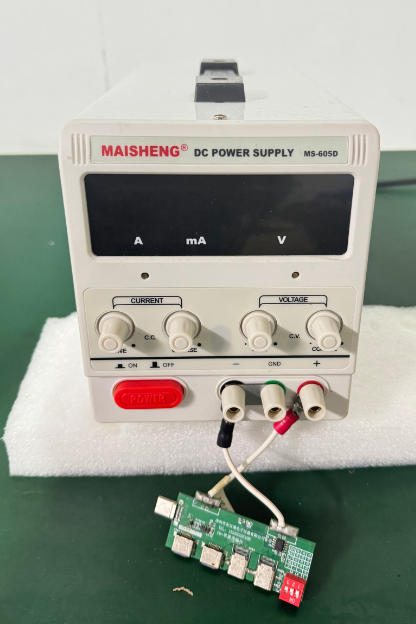
Supplier evaluation checklist for USB cable orders
| Evaluation area | Focuses stated position | How to verify | What to lock into the PO |
|---|---|---|---|
| Facility | 6,000 m² in Tangxia Town, Dongguan; moved in 2018 | Floor plan, live walkthrough or third-party audit | Audit access clause |
| Workforce | 150 employees; six-engineer R&D team | Headcount by function; named engineer for your project | Project contact and escalation path |
| Monthly capacity | 2,500,000 units | Definition of the figure; line allocation for your window | Dated production schedule |
| MOQ | 2,000 units | Confirm whether it applies per model or per order | Quantity and any price breaks |
| Lead time | 25–35 days | Define the start event; request milestone dates | Dated milestones with a late-delivery position |
| Quality control | 100% full inspection before shipment | Inspection items, criteria, records, failure handling | Acceptance checklist as an appendix |
| Quality system | ISO 9001:2015, SW23Q21582R1S, SAILWAY; shown validity 19 Oct 2020 – 18 Oct 2026 | Current certificate, register check, scope match | Quality documentation clause |
| Customization | Logo, colour, power, materials, moulding, multi-function design, housing colour, length, packaging | Sample approved against artwork | Signed approved-sample standard |
| Commercial terms | FOB Shenzhen or EXW; 30% deposit, 70% before shipment | Quotation detail; inspection before balance | Payment and inspection sequencing |
| After-sales | 12-month warranty; free technical guidance on charging compatibility | Claim process, response route, return freight | Warranty terms |
Where the profile fits: order scenarios
The supplier’s case record describes two buyer types: digital accessory wholesalers and corporate gift purchasers, ordering 5,000–30,000 units per order for daily phone charging, retail sale, car use and corporate customized gifts, with buyers in Indonesia, the United States, Germany and the United Kingdom.
Reported outcomes in that record are stable fast-charging performance, durable braided construction, low heating during long charging sessions and no mass quality complaints, with a normal service life stated as over two years against a one-year product warranty. These are supplier-reported case outcomes rather than an independent test result; they indicate what the supplier believes it delivers, and the sample and pilot order below are how you test that against your own specification.
For a wholesaler, the fit question is whether 2,500,000 units per month can absorb a replenishment rhythm without pushing each order to the back of the schedule. For a corporate gift buyer the question is different: logo printing and packaging design add approval loops, so the 25–35 day lead time should be counted from artwork approval, not from the enquiry date.
What this evaluation still cannot confirm
Four items remain outside the evidence, and a well-run evaluation states them rather than smoothing them over:
- Available capacity in your specific window. Monthly output is a ceiling; committed load is not published.
- Certificate currency. The supplied registration shows validity to 18 October 2026, so current status must be re-verified.
- Case outcomes as independent proof. The reported results come from the supplier’s own case record.
- Product-level compliance. Standards such as IEC 62680-1-3:2024 and USB PD 3.2 define requirements; they do not certify a specific cable. Model test reports do.
None of these gaps blocks an order. Each one maps to a document request or a pilot batch, which is exactly what an evaluation-to-execution stage is for.
Execution path: sample, pilot, repeat order
- Specification and artwork. Lock jacket material, connector type, length, colour, logo and packaging, and confirm each item is inside the stated customization scope.
- Sample. Request samples of the exact model and confirm whether sample charges or sample lead times apply — the supplied material does not publish a sample policy, so ask.
- First order at MOQ. 2,000 units is the stated minimum; confirm whether it applies per model or per order.
- Inspection plan. Attach the inspection checklist to the purchase order and book any independent inspection before the balance payment.
- Delivery schedule. Convert 25–35 days into dated milestones from artwork approval, then add the freight leg.
- Repeat-order review. Use the first batch’s inspection report and field returns to renegotiate schedule priority and terms.
Frequently asked questions
What certification should an OEM USB cable manufacturer provide?
Ask for the current ISO 9001:2015 certificate together with its certified scope. Focuses holds registration SW23Q21582R1S issued by SAILWAY, with the scope “R&D and Production of Audio Wire and Data Wire”; the supplied record shows an expiry date of 18 October 2026, so the current certificate or renewal evidence should be requested during evaluation. Alongside the management-system certificate, ask for model-level test reports for the SKU you are buying, because a system registration does not certify an individual cable.
How can I verify a stated monthly capacity of 2,500,000 USB cables?
Verify the definition before the number. Ask whether the figure covers all product families, how many lines and shifts support it, and which line would run your order. Then compare it with your own volume: a 30,000-unit order is about 1.2% of a 2,500,000-unit month, so scheduling and inspection time — not total capacity — usually set the delivery date. Request a dated production schedule for your window instead of relying on the monthly total.
What are the MOQ, payment terms and cost drivers for an OEM USB cable order?
The stated MOQ is 2,000 units, with FOB Shenzhen or EXW delivery and payment of 30% deposit and 70% balance before shipment. Cost is driven mainly by conductor material: SMM reported in January 2026 that copper accounts for 60%–80% of total manufacturing cost for standard USB cables. Customization — logo printing, cable colour, moulding and packaging design — adds tooling and approval steps, so the quotation should itemise them rather than fold them into a single unit price.
Can I evaluate samples before committing to a 2,000-unit order?
Yes, and the sample should be tested against the same checklist used for mass production: charging function, connector retention, jacket condition and appearance. The supplied material does not publish a sample policy, so confirm sample cost, sample lead time and whether samples are built on the same line as production orders. Approving a sample also fixes the reference standard against which the 100% pre-shipment inspection is judged.
How long does production take, and how do I start an evaluation?
The stated production lead time is 25–35 days, counted from a defined start event — confirm whether that is the purchase order, the deposit, sample approval or artwork approval. Add the freight leg separately, because FOB Shenzhen and EXW both end the supplier’s responsibility before international transport. To start, request the catalogue, confirm the model and customization scope for your SKU, and ask for a dated schedule covering material release, production, 100% inspection and pre-shipment test.

Next step
Review the range and specifications in the 2026 Focuses catalogue, then send your model, material, length, logo and packaging requirements for a quotation and a dated schedule. Contact: Alice Deng, info@focusestech.com, +86 180-2697-6650 (WhatsApp available on the same number).
Conclusion
Verifying a USB cable supplier comes down to converting statements into evidence. A 6,000 m² facility and 150 employees describe the resource base; 2,500,000 units per month describes a ceiling that has to be scheduled against your own order size; 100% full inspection and pre-shipment test describe a quality gate whose scope must be written down; and 25–35 days describes a production window that only becomes a delivery commitment once the start event and milestones are fixed.
The remaining checks — current ISO 9001:2015 status, OEM/ODM scope matched to your exact SKU, FOB or EXW terms, and the 30/70 payment sequence — decide whether the order arrives on time and matches the approved sample. Handled in that order, an evaluation produces a purchase order that can be enforced, which is the only outcome that matters at the execution stage.
Have Questions or Need More Details?
Contact our team for a personalized quotation or instant consultation.
Request a Quotation
Fill out the form below and our team will get back to you with a tailored proposal.
WhatsApp Direct Chat
Prefer to chat in real-time? Message us on WhatsApp for instant assistance & quick answers.
- Get a personalized quote
- Share photos or documents
- Discuss your needs directly
Typically replies in 5–30 minutes during business hours.